
Stop driving by next quarter. Start dispatching within 30 days.
An 18-module dispatcher curriculum built by a 10-year OTR driver, 10-year recruiter and dispatcher, and certified CDL instructor. Self-paced, FMCSA-compliant, and the only dispatcher course shipped with a 60+ page guidebook and 30+ working templates.
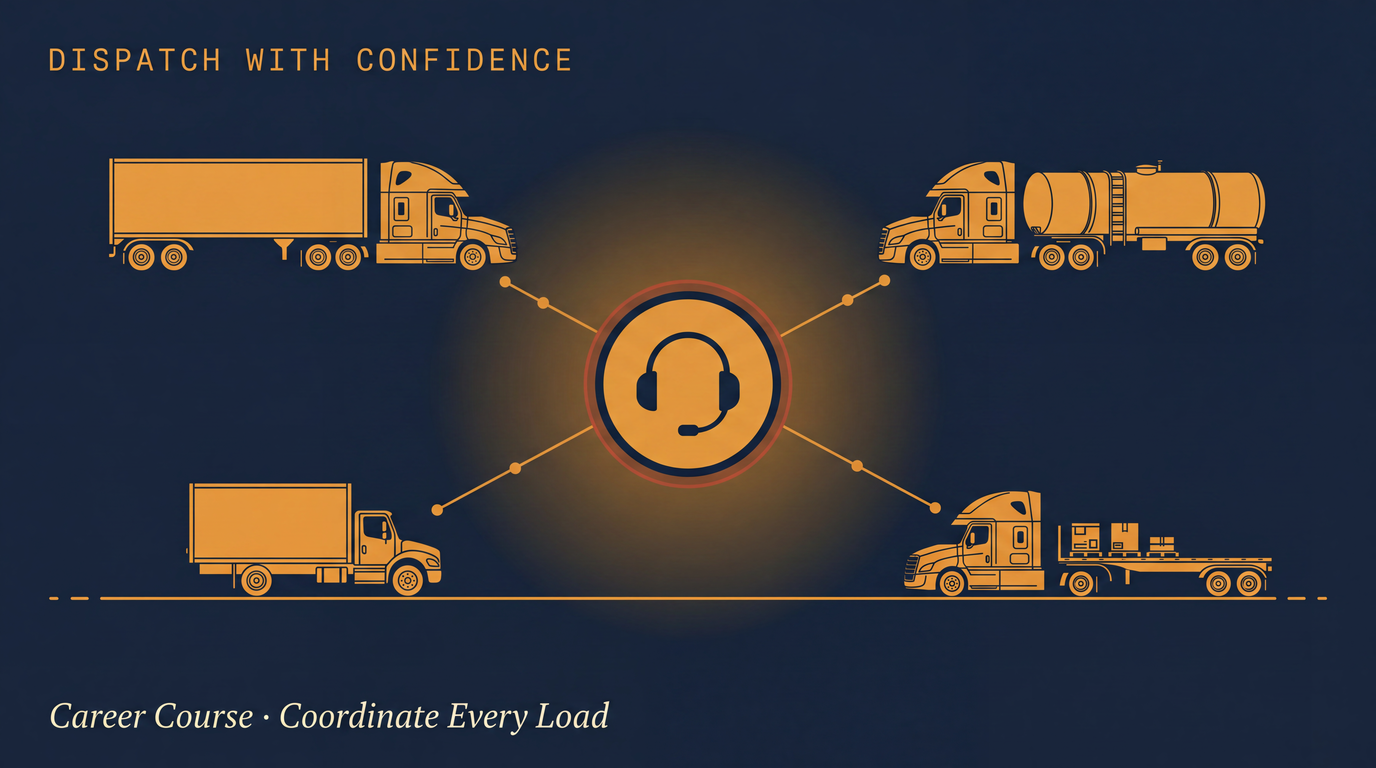
Three paths in. One curriculum.
Whether you're done with OTR life, dispatching your own truck, or building an independent dispatch service — this course is built around the same 18 modules of working-dispatcher knowledge. The path you take through it is your call.
Trucker coming home
You've spent years on the road and you're ready for home time, regular hours, and a desk job that still rewards what you already know about freight. Dispatching pays $50K–$95K and uses every instinct you developed driving.
Owner-operator self-dispatching
You own your truck and you're done paying a dispatcher 5–10% of every load. Learn to source freight, negotiate rates, and run your own back-office — and keep what you earn.
Independent dispatch service
You want your own dispatch business, multiple carriers, and a real income stream. Learn the legal structure, broker relationships, and operations — without learning the hard way.
18 modules. Everything you need to dispatch your first load.
Built from the ground up by a working dispatcher. Each module maps to real industry skills you'll use from your first day at a desk.
Day-to-Day Realities
What a dispatcher actually does, hour by hour. Set expectations before you invest.
Industry Players & Roles
Carriers, brokers, shippers, factoring companies — who pays whom and why.
FMCSA Compliance Foundation
The federal rules that make or break your operation. The Central Compliance Rule.
Setting Up the Business
LLC, EIN, agreements, software stack, startup costs ($2,500–$5,500 first year).
Truck Types & Equipment
Dry van, reefer, flatbed, tank, specialized — and what freight matches each.
Load Boards & Freight Sources
DAT, Truckstop, direct shipper relationships. Where the loads actually live.
Rate Negotiation
Know your numbers. Read the market. The Rate Negotiation Call Script.
Booking & Confirming Loads
Rate cons, BOLs, broker setup packets, the documents that protect you.
Carrier Acquisition
How to find carriers, vet them, sign them — without getting burned.
Multi-Carrier Operations
Tracking territories, equipment, commodities. The Carrier Scope Tracker.
Carrier Retention
Why carriers leave dispatchers. Monthly review framework that keeps yours.
Broker Relationships
Who's reliable, who pays slow, who'll burn you. Broker objection-response matrix.
Hours of Service & ELD
14-hour clock, 11-hour driving, the math your driver does that affects your booking.
Fraud, Double-Brokering & Risk
The traps that cost dispatchers thousands. Fraud Red Flags Reference Card.
Money & Cash Flow
Factoring, quick pay, billing cycles. When you actually get paid.
Lane Profitability
All-In Cost-Per-Mile Calculator. Know which lanes pay and which lose.
Seasonal Freight Cycles
Produce season, peak retail, Q1 slumps. Planning the year, not the week.
Building Your First 30 Days
Step-by-step plan to dispatch your first paid load within 30 days of finishing.
A complete curriculum package — not just videos.
Every other dispatcher course is some videos and a quiz. This one ships the full kit you'd get at a trade school — on day one, in your inbox.
18-module video & written curriculum
Self-paced. Every concept explained two ways — for visual learners and readers alike.
60+ page companion guidebook (PDF)
Printable, yours to keep. Every regulation cited from primary federal sources, with plain-English translations.
30+ downloadable working tools
Rate calculators, agreement templates, call scripts, fraud reference cards, carrier trackers. Not theory — the tools dispatchers actually use.
Direct instructor support
Questions go to Terry. Not a call center, not a forum — the instructor who built the course.
Free lifetime refresher access
Regulations change. Your access doesn't expire. Come back anytime, no extra charge.
The First 30 Days Action Plan
A step-by-step checklist for moving from course completion to first paid load. Built into Module 18.
Companion workbook available
The Dispatch with Confidence Companion Workbook (paperback, Amazon) is built directly from this course material. Optional, but a great offline reference for the working dispatcher.
This isn't a course built by a tech company.
Terence Mullins
Twenty years inside the trucking industry. Started as an OTR driver. Spent ten years in driver recruiting and dispatching. Twenty years in software, sysadmin, and operations management. Currently a certified CDL instructor with the Pennsylvania Training Manager Certificate and four years as a Driver's Education instructor in Medina, OH.
Author of Mastering Split Logging: A Trucker's Guide — the book that taught a generation of drivers how to actually use the split-sleeper provision instead of fighting it.
This course exists because the dispatcher training I saw on the market — including the $1,500 trade school programs — left students unprepared. So I built the course I wished existed.
- 10 years OTR driving — long-haul, regional, drop-and-hook, hazmat
- 10 years recruiting and dispatching — carriers from owner-ops to mid-size fleets
- 20 years operations and software management — the systems that run dispatch desks
- 10 years certified CDL instructor — PA Training Manager Certificate
- Author — Mastering Split Logging, available on Amazon
- Author — Dispatch with Confidence Companion Workbook, available on Amazon
What students ask before enrolling.
How long does it take to complete the course?
Most students finish in 4–8 weeks of part-time study (5–10 hours per week). The course is self-paced, so faster is possible if you have full days available. The 18 modules total roughly 30–40 hours of instruction, plus reading the guidebook and working through the downloadable tools.
Can I really start dispatching loads within 30 days of finishing?
Yes — if you follow Module 18's 30-Day Action Plan. That module covers exactly what to do day-by-day after you finish: setting up your business, signing up for load boards, contacting carriers, getting your first broker setup packets approved. Students who follow the plan have dispatched their first load in as little as two weeks. Students who skip the action plan can take months. The course shows you the path; walking it is on you.
How much can I actually earn as a dispatcher?
In-house dispatchers (working for a trucking company) earn $50,000–$95,000 per year depending on region, fleet size, and experience. Independent dispatch services typically charge 5–10% of gross revenue per carrier — one full-time carrier at $200,000/year nets you $10,000–$20,000 from that single relationship. Owner-operators self-dispatching keep the entire 5–10% they'd otherwise pay out, which is real money on a $250K+ annual gross. Income depends heavily on your effort, your carrier relationships, and your market.
Do I need a CDL or trucking experience to take this course?
No CDL required. No trucking experience required. Module 1 covers industry fundamentals from zero. That said: if you have driving experience, the course will land faster — you'll already understand HOS, equipment types, and what drivers actually need from a dispatcher. About half our students come from driving; the other half come in cold and do fine.
Is this an FMCSA-approved Training Provider Registry course?
No — FMCSA's Training Provider Registry covers ELDT (Entry-Level Driver Training) for CDL endorsements. Dispatcher training isn't a federally regulated profession, so there's no registry to be on. What this course IS: a complete, real-world dispatcher curriculum built by someone who's done the job, not a tech company recycling DMV handbook content. The course meets the standards of community college dispatcher programs, and many students who've taken both have told us they got more out of this one.
Do I need to register a business to start dispatching?
It depends on what kind of dispatching you do. If you're working in-house for a trucking company, no — you're an employee. If you're self-dispatching your own truck as an owner-operator, no — your trucking business is your business. If you're starting an independent dispatch service for multiple carriers, yes — you'll need to set up an LLC, get an EIN, and have proper agreements with each carrier. Module 4 covers exactly how to do this, including state-by-state filing notes.
What's the difference between a dispatcher and a freight broker?
A broker arranges freight between shippers and carriers and takes a margin on the rate. Brokers need an MC license, a $75,000 surety bond, and FMCSA authority. A dispatcher works on behalf of one or more specific carriers, finding loads for those carriers (usually from brokers and load boards). Dispatchers don't need FMCSA authority. Module 3 covers the legal distinction in detail — this matters because doing dispatcher work that crosses into broker territory is a federal violation.
Is there a refund if it's not for me?
Yes — a 7-day refund is available if you haven't started the course content. Once you begin working through the modules, the course is yours for life — including all future updates and revisions. Full refund terms are in our Terms of Service.
Can I contact Terry directly with questions during the course?
Yes. Direct instructor support is included — not a call center, not a forum. Email goes directly to Terry. Most questions get answered within one business day. Complex questions (regulatory interpretations, specific carrier-onboarding scenarios) sometimes take longer but always get answered.
Why is this $497 when other courses cost $99?
Honest answer: the $99 courses are videos and a quiz. This is a complete curriculum package — 18 modules, a 60+ page guidebook, 30+ working tools, and direct instructor support. The community college version of this course costs $1,500–$3,000. The trade school version costs $5,000+. We sit in between — priced for serious students who want real preparation, not the cheapest path to a certificate of completion.
Stop driving by next quarter.
The 18 modules. The guidebook. The 30+ tools. The first 30 days plan. The instructor who actually does the work.
It's all in there. The only thing missing is you.